

THE MARK TWAIN HOUSE & MUSEUM TO HOST “CREATIVE WRITING IN THE AGE OF AI” SYMPOSIUM NOVEMBER 7
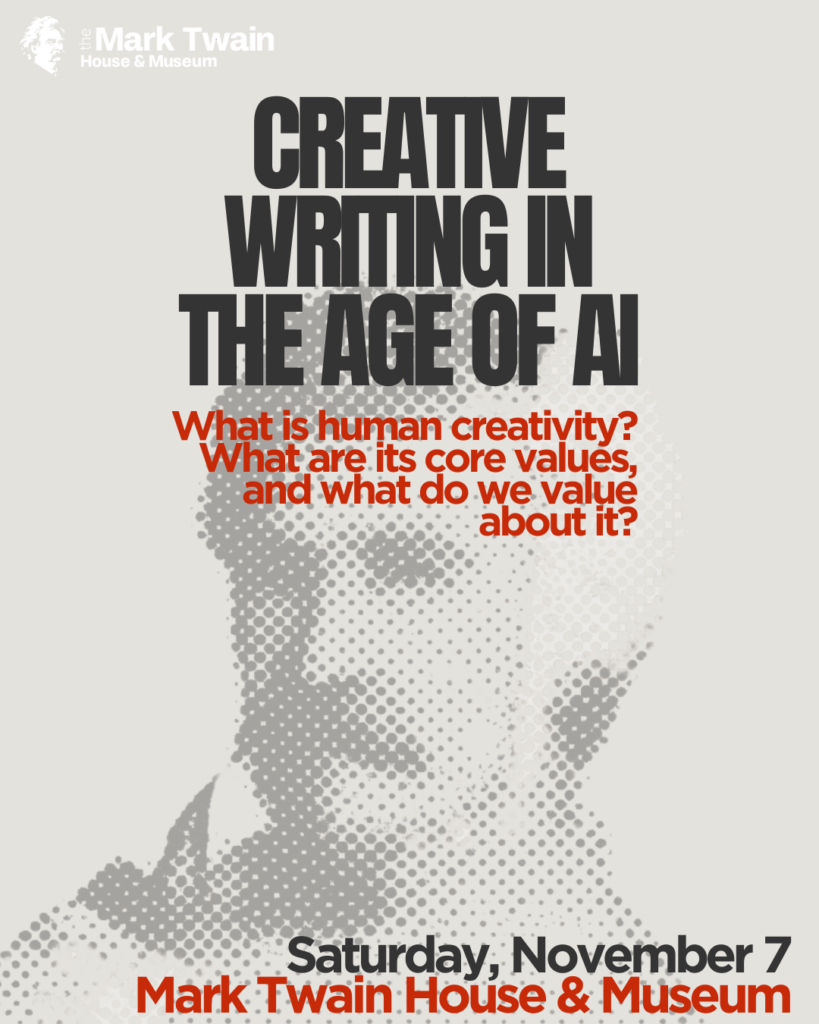
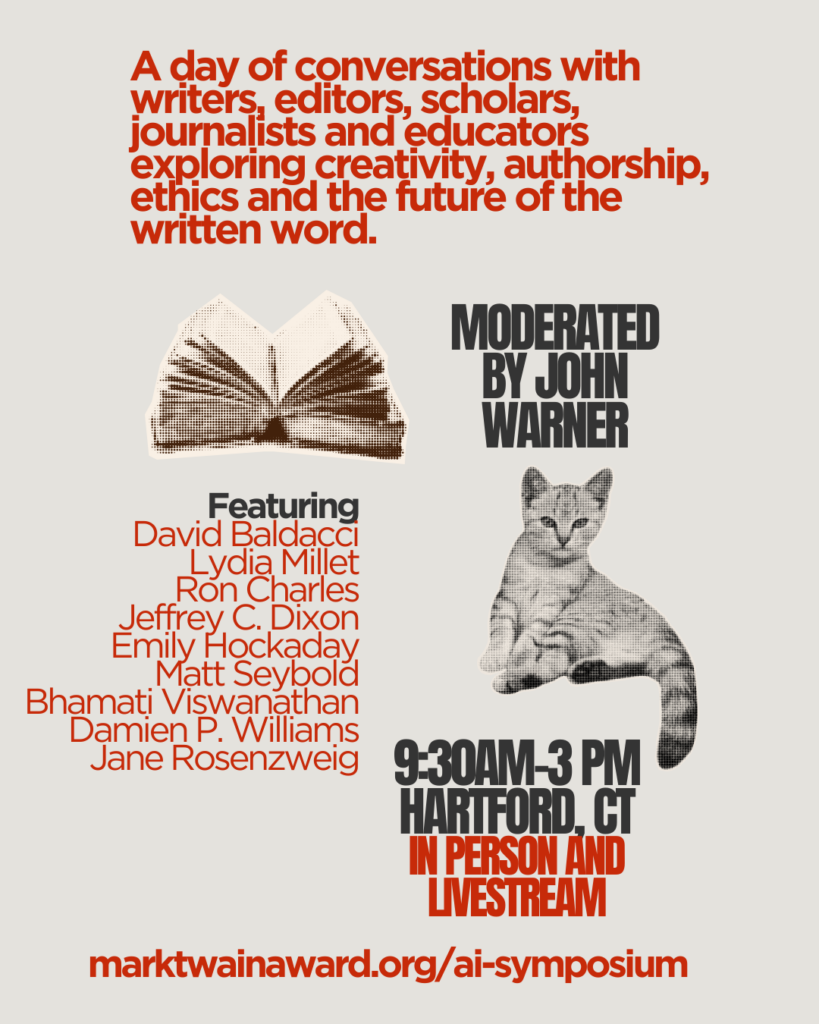
Writers, editors, scholars, journalists, and educators will gather in Hartford for a day of conversations about artificial intelligence, creativity, and the future of the written word.
HARTFORD, Conn. – October 5, 2026 – What is human creativity? What are its core values, and what do we value about it? Given the presence and increasing sophistication of generative artificial intelligence, how do we preserve those values, protect creative labor, and promote engagement with the literary arts for all?
The symposium will be moderated by John Warner, writer, editor, and author of More Than Words: How to Think About Writing in the Age of AI. Participants will include 2026 Mark Twain American Voice in Literature Award winner Lydia Millet; former Washington Post book critic Ron Charles; former director of the recently shuttered Harvard Writing Center Jane Rosenzweig; and world-famous author and Museum board member David Baldacci, who is also a plaintiff in the Authors Guild’s lawsuit against various companies alleging illegal use of copyrighted materials in AI product training. In 2025 congressional testimony on AI and copyright, Baldacci said, “I’m sure there are aspects of AI that will also transform the world. But if you want to bet on which side is more transformational, for all of us, I will bet on books every single time.”
For more than 150 years, the Mark Twain House has stood on Farmington Avenue not simply as a monument to American creativity but also as a vibrant cultural institution that celebrates and supports the American voices of today. This symposium, on the site where Twain created some of the most famous works in American literature, continues the Museum’s historic legacy as a leader in conversations about creativity, ethics, technology, and what it means to be human.
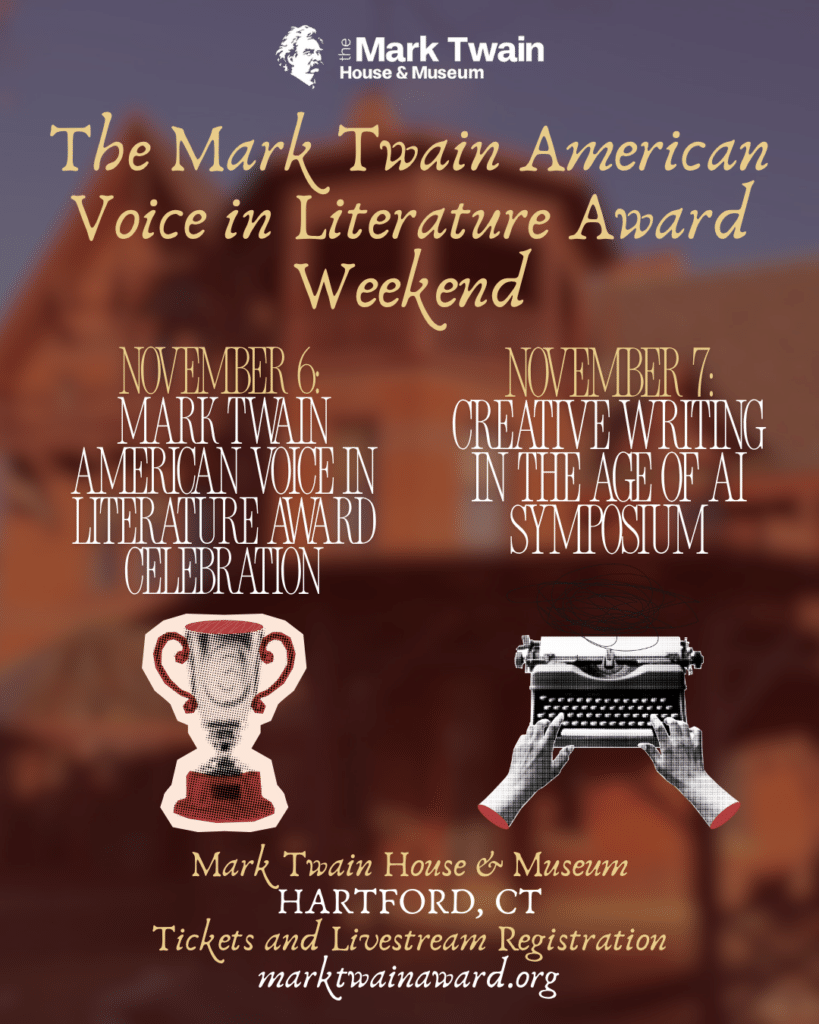
“Creative Writing in the Age of AI” takes place Saturday, November 7, 2026, at The Mark Twain House & Museum, 351 Farmington Avenue in Hartford. In-person and live stream registration are available, with discounted in-person tickets available for educators and students. All in-person tickets include lunch, coffee, and light snacks. Live stream tickets include access to the complete event, including participation in Q&A sessions.
For the complete schedule, participant information, and registration, visit: marktwainaward.org/ai-symposium. Media contact: Albinko Hasic.
The program will unfold through three broad conversations, “Frameworks,” “Authors & Editors,” and “Teaching, Learning, & Reading,” followed by a concluding roundtable, “What Now? What Next?”
“Frameworks” will examine philosophical, ethical, and legal questions prompted by the expanding use of generative AI, including the intersection of intellectual property and copyright law with the use of creative works in training AI systems, the ethical issues that undergird the use of those systems, and how the technology is being presented to and understood by the public. Panelists: Bhamati Viswanathan, Visiting Assistant Professor, Suffolk University Law School; Jeffrey C. Dixon, Professor of Sociology at the College of the Holy Cross; Damien P. Williams, Assistant Professor of Philosophy and Data Science, University of North Carolina Charlotte.
“Authors & Editors” will consider the impacts that generative AI is having on the creative labor of writers, editors, and publishers now that machine systems trained on that very labor are producing text, images, and other creative work at enormous scale. Panelists: David Baldacci, novelist and Museum board member; Lydia Millet, author and 2026 Mark Twain American Voice in Literature Award winner; Emily Hockaday, poet and editor of Asimov’s Science Fiction Magazine.
“Teaching, Learning, & Reading” will explore how generative AI is impacting the way people, young and old, interact with the written word, including conversations about book criticism, pleasure reading, the pedagogy of writing, and the ongoing use of student and teacher data to train the very AI systems that are being sold back to educational institutions. Panelists: Ron Charles, former book critic at The Washington Post; Jane Rosenzweig, former director of the Harvard Writing Center; Matt Seybold, Associate Professor of American Literature & Mark Twain Studies, Elmira College.
The day will conclude with a roundtable, “What Now? What Next?,” in which all panelists will help us imagine the path forward for literacy, learning, and the love of books.
ABOUT THE MARK TWAIN AMERICAN VOICE IN LITERATURE AWARD
Established in 2016 through the generous sponsorship of acclaimed novelist and Mark Twain House & Museum Board member David Baldacci and his wife, Michelle, the Mark Twain American Voice in Literature Award honors a work of fiction published in the previous calendar year that speaks with an American voice about American experiences. The Award carries a $25,000 cash prize and celebrates its 10th anniversary in 2026.
ABOUT THE MARK TWAIN HOUSE & MUSEUM
The Mark Twain House & Museum is the restored Hartford, Connecticut, home where Samuel Clemens, better known as Mark Twain, lived with his family from 1874 to 1891. During his years in Hartford, Twain wrote many of his most celebrated works, including Adventures of Huckleberry Finn and The Adventures of Tom Sawyer. Today, the Museum preserves Twain’s home and legacy through tours, exhibitions, educational programs, public events, and literary and cultural programming.